
by William McKinnon
First, an Introduction
Eyes On Napa is pleased to share this article with you as we start the New Year and consider the needs of our beautiful Napa Valley and everyone who lives here.
Our guest author is William McKinnon, an attorney for Water Audit California, a Public Benefit Corporation with highly regarded top advisors, including Dr Peter Moyle from UC Davis and Dr.Ted Grantham of UC Berkeley.
In the article below, McKinnon explains his view of Napa County’s standing in protecting one of our most vital resources: water. He is most effective when the person opposite him is willing to “measure and monitor,” accept the truth, follow the law, and collaborate to find a potential way forward. That path always involves water, the fish that rely on it, and the Public Trust. -The Editors
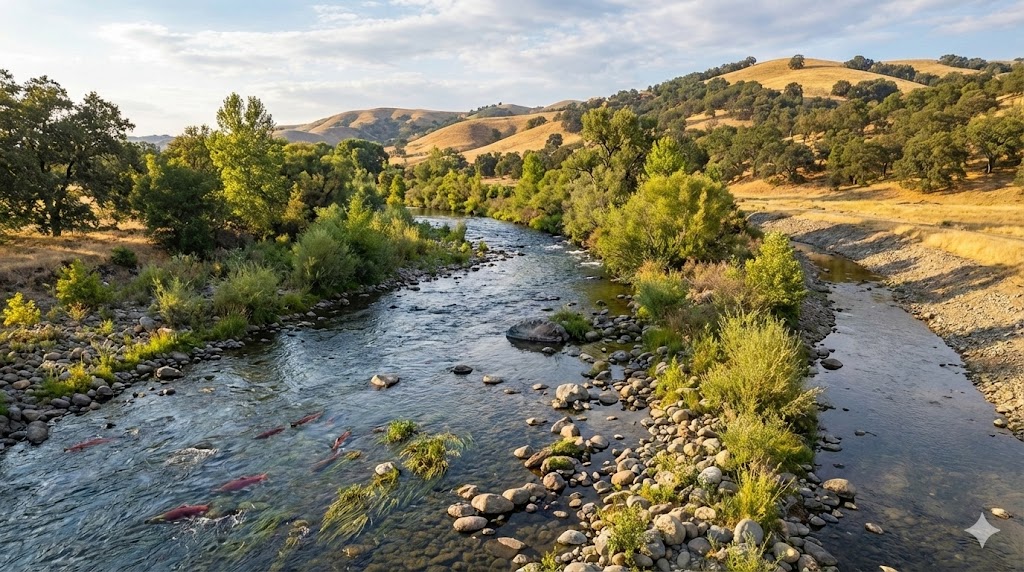
This is the tale of two counties …and an explanation of why one is having great success in repopulating its watercourse with fish, while the other continues to slog through litigation.
The major watercourses in Napa and Solano Counties are similar in their aquatic features, with the 55 miles of the Napa River supported by a 575-square-mile watershed, and the 70 miles of Putah Creek fed by a 425-square-mile watershed. Both are affected by significant human-made obstructions. Flow levels in both waterways vary greatly; for example, certain sections of the Napa River near the City of St. Helena can dry out completely during months when municipal and agricultural diversions occur. Putah Creek stays mostly wet all year, but flow rates range from peaks of 80,000 cubic feet per second (CFS) to lows of 5 CFS, which is the minimum needed for healthy salmon populations.
Twenty-five years ago, the once-abundant salmon populations in both counties had dwindled to just a dozen or so spawning fish annually. Instead of competing with agricultural interests, both watercourses were neglected by the California Department of Fish and Wildlife, the regulatory agency responsible.
This year, Putah Creek is tracking the return of roughly 2,000 spawning fish. We don’t have an official figure for the Napa cohort, but a reasonable estimate is about 200 fish, which is a lot better than a dozen but still not something to brag about.
Why such a big difference? Water Audit has dedicated significant time and effort in both counties, so we investigated and want to share our conclusions. In Solano County, the government is committed to doing the best it can with what it has and is adjusting its actions to succeed. Problems are identified and, over time, fixed. In Napa County, this doesn’t happen, with the best hope being that it won’t get much worse. Even volunteer efforts to improve the situation are often intentionally hindered by county actions or the lack of effort.
The “public trust” holds that certain natural resources cannot be privately owned and are held in common by everyone, including waterways and the fish associated with them. In California, this means that the people own all water, and private rights are merely conditional permissions to use the water. A fishing permit does not grant ownership of any fish but simply provides the conditional right to attempt to catch a fish.
In 1983, the California Supreme Court confirmed that California’s fishery is part of the public trust. In National Audubon, the Court held that, despite its earlier decades of draining Mono Lake, LA Water and Power had a preemptive duty to allow “sufficient” water to stay in the waterways to keep fish healthy downstream of diversions. When LA Power later argued that it did not know how much water it was required to release, the Supreme Court responded in Cal. Trout II:“release sufficient water into the streams from its dams to reestablish and maintain the fisheries which existed in them prior to its diversion of water.”
Subsequently, to bypass Water Board’s adherence to this principle when granting extraction permits or licenses in allocation decisions, water users started drilling wells near watercourses, which indirectlyled to the drying of connected waterways.
Over the past decade, courts have ruled that any water extraction that dries a public trust resource, whether directly or indirectly, violates the law. Whether someone dries a public trust watercourse by using a suction hose in the water or by drying it from a well, the legal outcome remains the same: it is illegal to dry a stream.
Napa County has chosen to debate the issue. In January 2020, when Water Audit argued that well-drilling permits contributed to the drying of the Napa River, planning director David Morrison announced, despite clear contradictory evidence, that there was no link between surface water and groundwater and declared that the County had no obligation to the streams. After litigation initiated by Water Audit in January 2024, the County changed its policy to require investigation of the groundwater and surface water connection when increased extractions are linked to new developments. Ignoring National Audubon and Cal. Trout II, Napa County still claims that existing damages are vested.
There are two perspectives to consider in this situation: the practical and the legal. The County and the named applicants have chosen to reverse the order and rely on legal arguments before addressing the real-world impact. Our position is that new rights cannot benefit from old injuries. In a published decision, the Court of Appeal recently supported our stance on the continuous accrual doctrine. Just because a problem exists does not mean it must persist.
Here’s the bottom line: Solano admitted five years ago that they had problems, and Water Audit helped them find a solution. There has been no litigation, and the issues are being resolved, with clear positive results. Napa, on the other hand, has chosen to defend the status quo through costly litigation, and the problem persists. The outcomes of these two approaches are plainly evident.
If people remain stubborn, there are only two options: let the current situation stay and gradually worsen, or use the law to enforce change. Water Audit stands for the public trust. While we will assist counties in finding solutions to impingements on the Public Trust, if counties are unwilling to change the status quo, we will take legal action. There is too much at stake if we do not.
Read more about Putah Creek successes here.